What I had to clear up at this point in my research was that Henry’s family were not from the group of Germans who were motivated to settle in colonies based on decrees created by Tsarina Catherine II of Russia. I based this on my locality studies of the region and colony where Henry’s family lived and where he was born. Henry’s family were Volhynian Germans who at one time settled in Poland after emigrating from Germany. They later migrated eventually to a location near Henry’s birthplace.
You may wonder what and where Volhynia was. It was an area, most of which is now in northwest Ukraine on the border with Poland and Belarus. It was ruled by Poland until the late 18th century. Poland at one time was split up into 3 parts ruled by 3 different empires–Prussian, Austrian and Russian.
After this 3-way split, Volhynia became a province or gubernia of the Russian Empire until 1919, when the western part of Volhynia once again became a part of Poland. Major cities and towns in and around Volhynia included Zhitomir or Zhytomyr, its former capital, Rovno, Rivne. These locations related to Henry and his wife Julia’s birth places. Refer to the map below to get a better idea of where these places were and are present day.
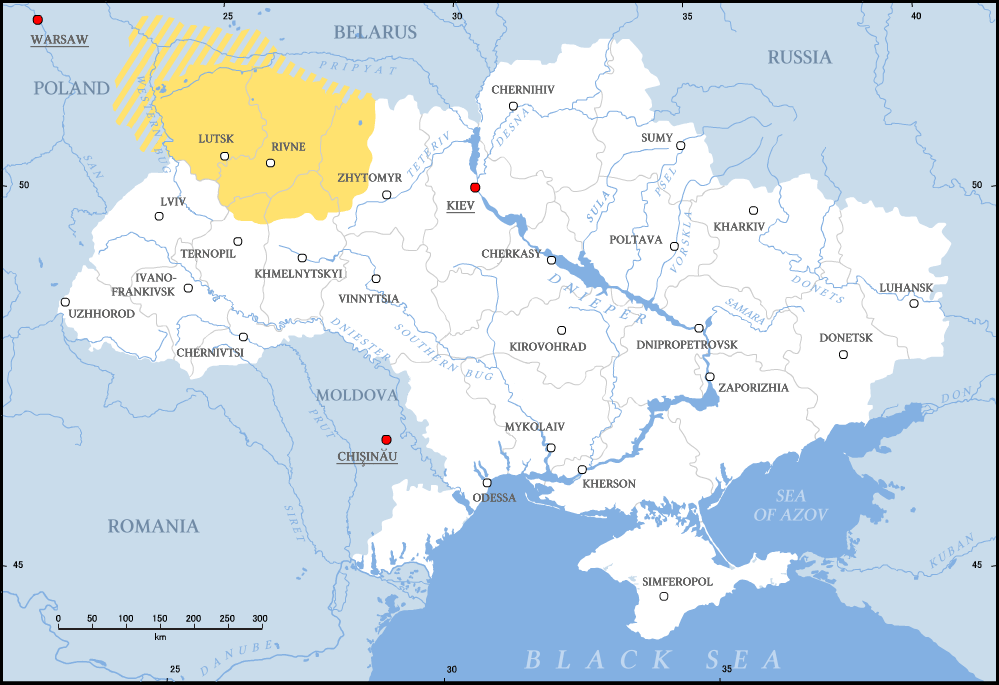
IMAGE SOURCE: https://en.wikipedia.org/wiki/File:Ukraine-Volhyn-en.png
Most likely what prompted this group of Germans to move to Volhynia was what happened after the abolition of serfdom in 1864. This event affected Polish nobility. They relied on serfs to work their land and suddenly lost them as workers. Serfs at that time were considered to be what you call cheap labor. A lot of the land, which was land the nobles were able to keep after Russian occupation, was not the best–swamps, forests and land not suitable to grow anything.
The nobles then sent out recruiters specifically requesting that German farmers/colonists who settled in villages in central Poland move to Volhynia. The nobles needed them to clear forests and improve the quality of the land such that crops could be grown.
It appeared to be a win-win situation for both the nobles and the colonists. It was well known at the time that these colonists had the agricultural skills to pull this off. Land use in exchange for labor to clear forests and land that was cheaper in Volhynia to purchase than in central Poland appealed to the colonists.
It should be noted that, since the Russian government didn’t sponsor the emigration of these German colonists to Volhynia, those colonists who settled there didn’t receive any benefits or privileges. The only privileges received were those provided by the local Polish nobles.
Sources: “Matschulek: 1 General information about Volhynia” ( https://ahnenforschungwolhynien.wordpress.com/chronik/kap-1), “Ukrainian Genealogical Society: Volhynia” (https://sites.rootsweb.com/~ukrgs/volhynia/index.html)

