• VOLHYNIAN GERMANS – SUMMER 2024

    What I had to clear up at this point in my research was that Henry’s family were not from the group of Germans who were motivated to settle in colonies based on decrees created by Tsarina Catherine II of Russia.  I based this on my locality studies of the region and colony where Henry’s family lived and where he was born.  Henry’s family were Volhynian Germans who at one time settled in Poland after emigrating from Germany. They later migrated eventually to a location near Henry’s birthplace.

    You may wonder what and where Volhynia was.  It was an area, most of which is now in northwest Ukraine on the border with Poland and Belarus.  It was ruled by Poland until the late 18th century.  Poland at one time was split up into 3 parts ruled by 3 different empires–Prussian, Austrian and Russian.

    After this 3-way split, Volhynia became a province or gubernia of the Russian Empire until 1919, when the western part of Volhynia once again became a part of Poland.  Major cities and towns in and around Volhynia included Zhitomir or Zhytomyr, its former capital, Rovno, Rivne.  These locations related to Henry and his wife Julia’s birth places. Refer to the map below to get a better idea of where these places were and are present day.
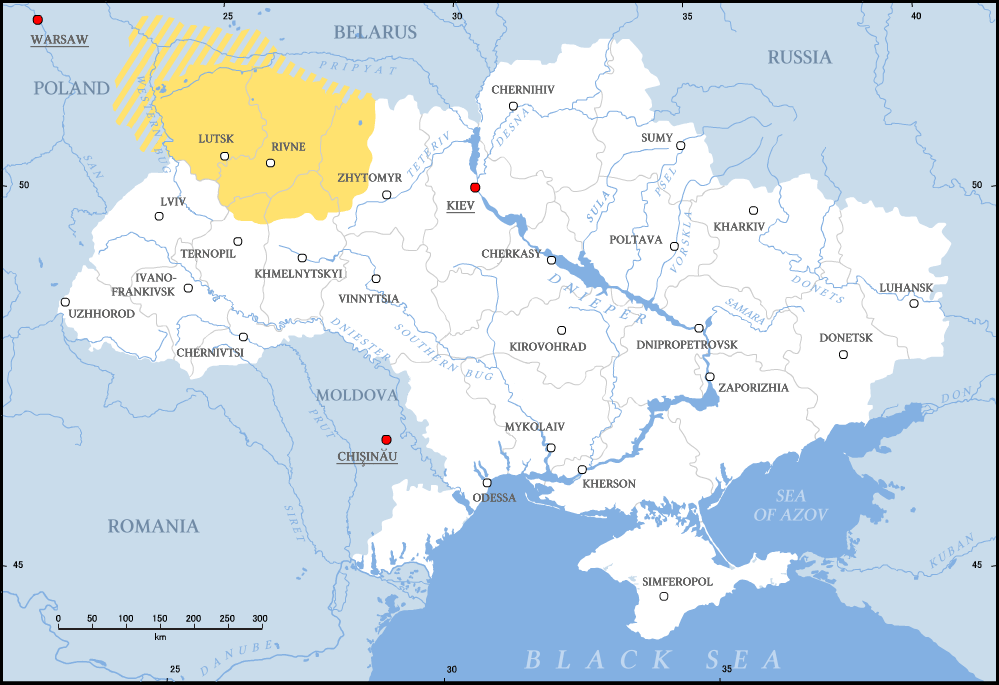
    IMAGE SOURCE: https://en.wikipedia.org/wiki/File:Ukraine-Volhyn-en.png

    Most likely what prompted this group of Germans to move to Volhynia was what happened after the abolition of serfdom in 1864. This event affected Polish nobility. They relied on serfs to work their land and suddenly lost them as workers. Serfs at that time were considered to be what you call cheap labor. A lot of the land, which was land the nobles were able to keep after Russian occupation, was not the best–swamps, forests and land not suitable to grow anything.

    The nobles then sent out recruiters specifically requesting that German farmers/colonists who settled in villages in central Poland move to Volhynia. The nobles needed them to clear forests and improve the quality of the land such that crops could be grown.

    It appeared to be a win-win situation for both the nobles and the colonists.  It was well known at the time that these colonists had the agricultural skills to pull this off.  Land use in exchange for labor to clear forests and land that was cheaper in Volhynia to purchase than in central Poland appealed to the colonists.

    It should be noted that, since the Russian government didn’t sponsor the emigration of these German colonists to Volhynia, those colonists who settled there didn’t receive any benefits or privileges. The only privileges received were those provided by the local Polish nobles.

    Sources: “Matschulek: 1 General information about Volhynia” ( https://ahnenforschungwolhynien.wordpress.com/chronik/kap-1), “Ukrainian Genealogical Society: Volhynia” (https://sites.rootsweb.com/~ukrgs/volhynia/index.html)
  • AN ACCIDENTAL FINDING – JUNE 2024

    I worked with Keri from April to June 2024.  We couldn’t find much more about Henry’s family.  We did start research on Julia’s paternal side of the family and found records which needed transcription.

    Meanwhile, I didn’t stop checking occasionally for records regarding the Tumms.  It was late June 2024 that I revisited the search for the wedding document for Marcin Tom/Tumm Dorota Weserling.  It was by accident that I did find this, which was supposed to be found in Boryslawice Koscienie Catholic parish entry 11/1824.

    I was looking in what is called the BaSIA Database of Archival Indexing System, at first thinking I found a death document for Marcin. I was able to access it and posted a Polish transcription request in a Facebook genealogy group I’m a member of.  That document turned out to not be for the Marcin related to Henry.

    While looking at the Basia Index for anything related to the surname of Tumm, Tom or Tomm, I found reference to Wilhelm Gottlieb Tumm’s birth/baptism record and to the wedding document.  It appeared that Marcin and Dorota were related to Henry.  I posted another Polish transcription request in the Facebook genealogy group for this document.  The translation revealed that the document indeed was for Henry’s relatives.  What a find!

  • MORE LOCALITY RESEARCH – MARCH 2024

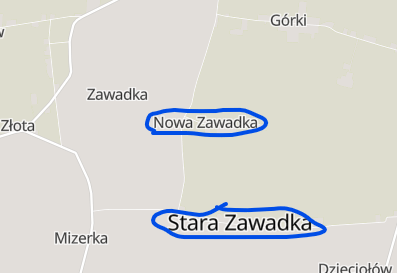
    In March 2024, Keri and I did locality research on the locations listed in the document scanned images we found. She was able to locate Derashno which was tracked to the current name of Derazhne. Nowa (new) Zawadka and Stara (old) Zawadka were two miniscule villages in that region.

    Snippet from https://mapcarta.com/N3009753193

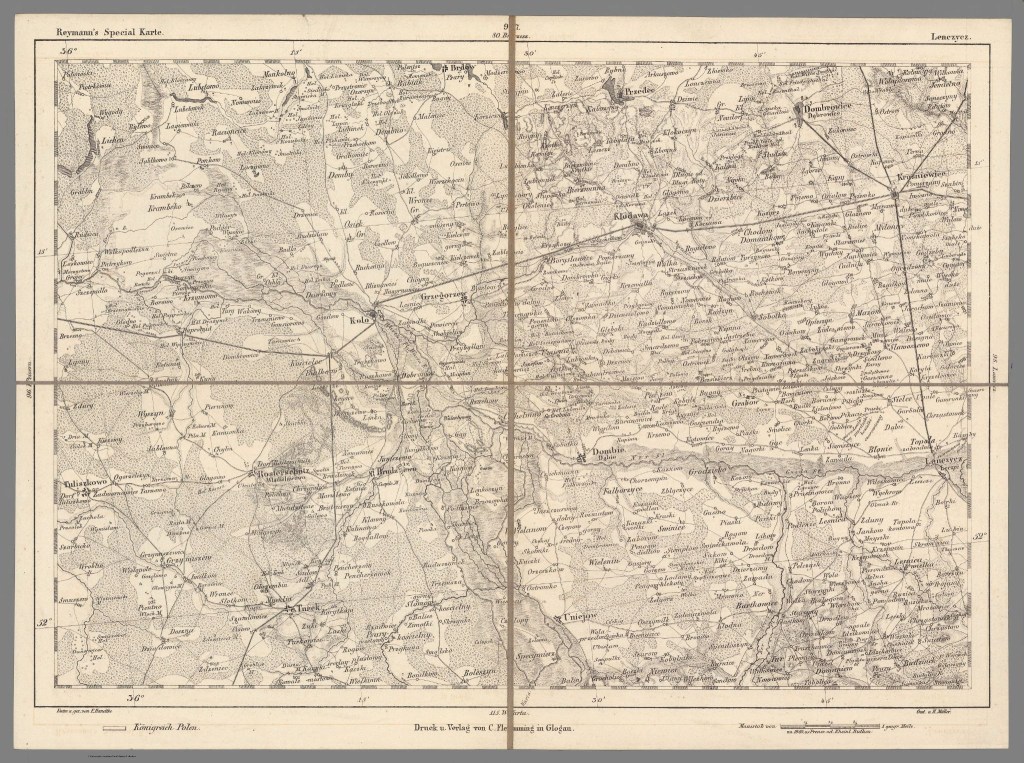
    I was able to find a map for the Kolo – Zawodki – Dabie region online from the 1850 Reymann Atlas, part of the Rumsfeld Map Collection.

  • BACK TO RESEARCHING HENRY’S PATERNAL FAMILY

    Working with Keri into February 2024, it was then that she found a record listed on a website of record listings for Wielkopolskie or Greater Poland, Gniazdo or Greater Poland Genealogical Society.  It was this record that told us what Fred or Friedrich’s father’s name was, Wilhelm Gottlieb or Bogumil Tumm.  Keri told me it was likely that Wilhelm’s mother died in childbirth when he was born.  We also saw that Wilhelm (Gottlieb Timm), 19 years old, married Anna Rosine (Rozyna) Hoffmann, 24 years old whose father was Krzysztof Hoffmann and mother was Anna Luiza Kyhn. 

    It was recommended that I search within records in Projects for Catholic parish Boryslawice Kosciene, since Gniazdo gave info about a wedding for Wilhelm’s father Marcin Tom, age 25, and Dorota Weserling, 22 years old per Boryslawice Koscienie Catholic parish entry 11/1824. 

    By this point, it was mid-February 2024.  I circled back to SGGEE looking at an entry for Marcin (Martin) Tumm and the rest of the Tumm surname listing, for which the source was ‘many parishes in Poland.’  I had to contact someone at SGGEE to request the family group sheets for Wilhelm Gottlieb Tumm and Anna Rosine Hoffmann, Marcin Tumm, Anna Dorothea Wesserling (wife of Marcin) and Friedrich Tumm.  I also requested the FamilySearch film number and registration number.  I needed the latter to obtain scans of original documents.   

    This proved to be helpful along with a link to Szukawarchiwach, a Polish archive website, where I was able to get access to an image for Wilhelm Tumm that I wasn’t able to access on FamilySearch.  The family group sheets provided names of Friedrich’s siblings, their birthdates and birthplaces.

    I also was able to create a family group sheet for Anna Rosine Hoffmann’s family, pulling info off SGGEE. This enabled me to explore further into descendants of her family so that should I encounter them in other DNA match trees, I could better visualize connections.

  • COLLATERAL RESEARCH – JULIA’S SIBLINGS

    Toward the end of January 2024, after a review of Ancestry DNA matches, I discovered a match whose grandparents were Henry’s wife Julia’s sister and brother-in-law, Amalia (Harmel) and John Saiger.  Ancestry pulled up a US Border Crossings document as a hint that showed Henry had helped this couple come to Neche, North Dakota, along with a child.  Henry was listed as Henry Tom, brother-in-law.  There was also a naturalization record for John indicating that Amalia was born in Matchulik, Poland. 

    It was interesting, as I explored this further into the beginning of February 2024, that Amalia and John’s oldest son was born like Henry in Klevan, Russia.  Further exploration led to my finding in a 2-volume set of books, Proudly We Speak, Volume I, a biography about John Saiger and his family.  The biography stated that John came to the Neche area from Russia in 1900, the same year that Henry arrived.  I began to wonder if John was the brother referred to in the story about Henry fleeing with a brother.  John was already married to Amalia then.  Who knows, I wondered.

    The biography also provided names of Amalia and John’s children including married surnames of the family’s daughters. This sparked my interest in pursuing some more collateral research.  Even though Amalia wasn’t a direct ancestor to me, I didn’t want to miss the opportunity of gaining some information about Henry through her descendants.  Amalia is what you call a collateral relative, an in-law to my direct ancestor Henry.

    My next move was to check out Ancestry DNA matches for surnames associated with Amalia and John in DNA match trees.  I found two matches whose direct descendants were Amalia and John as either grandparents or great-grandparents.

    Before making any connection with the matches, it was time to “do the genealogy” first.  This meant following my usual process of checking out:

    • Vital records like birth, marriage, death
    • Censuses
    • Obituaries
    • Other records that could give some insight as to names of descendants and their families

    I took the time to create spreadsheets and logs with my findings.  Then it was time to connect with Amalia and John’s living descendants.  

    The DNA match profiles showed that they were not online in their Ancestry accounts for quite some time. I checked Facebook out, after a Google search revealed that one of the matches had a Facebook account.  It looked like the match wasn’t that active on Facebook either.  

    Further investigation identified some people who appeared to be family members.  I reached out to one of them who graciously responded to a chat and identified how the matches were connected to Amalia and John.  I was also provided with a phone number of a good family source to speak with about the couple.  

    Although I didn’t get that much more information about Henry with this research strategy through living descendants, I did find my research efforts paid off.  This did provide me with some background as to how Henry and Julia probably met.

    I wasn’t done pursuing collateral research in regard to Julia and her family, as while I worked with my genealogist coach Keri some old records related to them were found. These would help shape out Julia’s story when I got to that point in writing about Henry and Julia. Who knows what else I would find? Time would tell.

  • ANOTHER FIND – THE TOMM/HEIN 1876 MARRIAGE BANN

    I focused next on doing research on Henry’s mother, Mary.  I explored variations of her surname Haen which included Hehn, Hein and Heine.  This resulted in not finding any documentation on Mary initially until I found a Johann Hein born in Mochulki, Volyn, Ukraine, on an Ancestry tree. 

    Further investigation with the help of my cousin on The Society for Germanic Genealogy in Eastern Europe or SGGEE website resulted in locating the marriage record for Henry’s parents.  It started with my cousin’s finding some time ago a Heinrich Tomm born in October 1876 in Shitomir, Zhitomir parish, with father being Friedrich and mother being Maria Hein.  I agreed with my cousin that this Heinrich may be our Henry.  

    Also found was an SGGEE entry for Eva Tomm born in August 1879.  The entry was for a baptism record for both Heinrich and Eva.  We wondered if perhaps Eva was his sister.  

    My cousin also told me about another record connected with Friedrich Tomm and Maria Hein–their marriage bann.  I shared this information with genealogist coach Keri and learned how to access the marriage bann’s digital scan, which was from a record book of communes of the Evangelical Augsburg Confession areas of the governorates of the Russian Empire/eastern voivodeships Polish Republic.  

    The bann was written in German.  I was able to have it translated with the help of others before sharing it with Keri. It was thought by those translating the marriage bann that the locations could be Nowe Zawadka, Dabie, Kolo, Posen.  Kreis Rowno was in Volhynia (now Ukraine).  This was most likely where Friedrich was.

    After I joined SGGEE as a member, which enabled me to do advanced searches for the surname Tomm, I was able to locate a marriage listing for Friedrich25 tomm. The ‘25’ represented his age at the time of his marriage and included the event day/month as 02 Jul 1876 at Roszyszcze with bride surname of Hein. The bride’s given name was Marianne 21. The groom’s parents were listed as Gottlieb Tomm and Rosina. The bride’s parents were Johann Hein and mother unknown.

    I was able to locate the pastor’s name within an article SGGEE provided about the history of the Volhynia Diocese, Roshischtsche Parish. SGGEE also provided maps showing German settlements in Eastern Europe. One map, available to SGGEE members only, showed Rowno and Zhitomir in the Volhynia region. This prompted my research on Wolhynia also known as Volhynia.

  • THE PUZZLING SOCIAL SECURITY APPLICATION

    After spending nearly half a year on this project, I could have given up, telling myself that I really gave this a try with the “doing the genealogy” skills I had.  But, I couldn’t let it go.  It was time to get some help.  

    It was in January 2024 that I hired a genealogist coach, Keri. I chose being coached by a genealogist because I didn’t want to miss out on the fun of a research challenge like this. I was going to “do the genealogy” with some advanced genealogy assistance.

    Shortly before I contacted Keri, a conversation I had with another cousin led us both to questioning a Social Security Application Index listing found on MyHeritage for who appeared to be Henry. It revealed his parents’ names, but without having access to the actual document, there was no way we would know if this was our Henry or not. I shared this with Keri as well as everything else I knew about Henry to this point.

    Keri told me about an SS-5 form that I could fill out and submit through the Social Security Administration website.  It would cost money to get a copy of the application Henry filled out and would take maybe a month to be processed.  Little did she know that there was an option to have the application copy delivered digitally. 

    Within a week I had access to the application copy. It revealed that it was our North Dakota Henry. What confirmed it was his signature. It was identical to the signatures on other types of documents I collected. The birth date, residence and occupation matched as well. It gave the names of his parents, Fred Thom and Mary Haen, and indicated that his birth place was Marclulick, Poland.

    I pursued research on the couple listed as his parents and shared this information with an Ancestry tree owner who was related to Henry’s wife Julia’s family. She shared that Julia’s parents’ families were from Moczulki (Marclulick, Poland), intermarrying with another family with some living a while in Neche, North Dakota. This to me indicated that Julia and Henry met while living in the same community.

  • ASK THE WIFE – JULIA’S ROOTS

    In December 2023, I had a lot of questions.  I wondered where Henry’s wife Julia or Julianna originated from. It was time to “ask the wife” in the hope that would give me some lead as to who Henry’s parents really were.  I did some online research, checking out the Odessa Digital Library St. Petersburg collections.  I found that Julia’s village of origin was Shitomir otherwise known as Zhitomir or Zhytomyr, Ukraine.  She was born in Mastchuliv.

    I then wondered if any of the Ancestry trees for DNA matches and non-DNA matches alike would give me some clues about Julia’s family.  I was able to get some names of her siblings.

    I next asked a cousin if he knew anything, after I caught him up to speed on what I did and didn’t find.  He shared location and ethnic group links.  He figured Henry’s family followed along with some Mennonite friends, since these friends didn’t care to assimilate to what Russia had in mind for them. 

    I did recall seeing in one of the Ancestry family trees a note that Henry fled some unnamed country together with his brother, name not mentioned. Supposedly, they were living on the border for a while until Henry was separated from his brother in Denmark or someplace nearby.  I messaged the tree’s owner regarding this notation, asking if she could give me some background on it.  She told me she heard the story from her father-in-law, who happened to be one of my DNA matches.  He heard it from another family relative.  Unfortunately, that family relative wasn’t alive for us to ask for more details.

    I was able to contact another Ancestry tree owner who appeared to be related to Julia.  I sent her an Ancestry message and found out she was related to Julia’s mother’s family.  She told me that Henry and Julia were married in Poland and arrived in Neche, North Dakota, within months of being married.

    Review of United States censuses for Henry revealed that Henry’s arrival was listed as 1900. An Ancestry tree suggested that Henry arrived in North Dakota first with Julia joining him a couple years later after he sent for her. There was also the comment that it was likely the couple wasn’t married yet to each other and that marriage took place upon arrival. 

    I concluded that looking into Julia’s roots was what I call a wild goose chase. Not coming up with any credible documentation regarding Julia and Henry’s marriage resulted in not finding out who Henry’s parents were.

  • HENRY’S BIRTH LOCALITY STUDY

    I spent the rest of November 2023 beginning a locality study on Henry’s birth place.  I couldn’t quite understand why the documents I had that spanned over a period of time had different locations:  Klevin, Russia; Rovno, Poland and Volhynia.  Sometimes, I wondered if he really knew where he was!

    What I did know was that he was born on October 15, 1877, in Rovno, Poland per his military card. He also mentioned Klevin, Russia, as a birth place, which according to him was under the sovereignty of the Russian Empire, on his naturalization document.

    I couldn’t locate Klevin, Russia, but did find Kieven, Russia, aka Kievan Rus. There’s even a YouTube video titled “Why Kyivan Rus is more likely Ukraine and not Russia.” [https://www.youtube.com/watch?v=qjgj4wnXHQI] Per a Wikipedia entry for Kievan Rus’ [https://simple.wikipedia.org/wiki/Kievan_Rus%27], it’s also known as Kyivan Rus.

    I reviewed other websites of interest about this location: 

    The closest thing to that city is in the Rivne Oblast in western Ukraine.  Rivne Oblast is a province. Rovno was the former spelling in Ukrainian until 1991. It was following the Second Partition of Poland in 1793 that Rivne became a part of the Russian Empire (the empire Henry referred to in his naturalization documents). In 1797 it was declared to be a county level (uyezd) town of the Volhynian Governorate. During World War I, it was briefly under German, Ukrainian, Bolshevik and Polish rule. So, it’s no wonder that in the documents I do have on Henry his birthplace could be Poland, Russia, Volhynia. It all depended on what rule the place was under at certain time periods. 

    Henry ended up in Canada for a short time in 1900.  Where he was between the time of his birth in 1877 and then was not known. 

  • WAS THE WAUTOMA FAMILY REALLY CONNECTED TO HENRY?

    By the end of November 2023, I was still working on the hypothesis that the Wautoma couple and their children were connected to Henry in North Dakota somehow. After all, they had the same surname and a couple of my paternal DNA matches were connected to a sibling of Ottilie. I saw that none of the other paternal DNA matches closest to me shared these two matches. This was because their centimorgan amount was very low compared to my paternal first and second cousin matches. My research question changed: Was the Wautoma family really connected to Henry? Were they the right family? 

    After pursuing every research avenue I knew and looking at William’s children’s vital records, I pursued collateral research amongst William’s siblings to see if I could find some living people with trees to contact, even though they weren’t DNA matches. One stood out on multiple genealogy sites besides Ancestry. It turned out that she was someone I knew from a Facebook genealogy group I belong to as well. I messaged her both on Ancestry and Facebook Messenger.

    I was happy when she responded, saying that she was glad to help and asked that I invite her on Ancestry to view my working family tree. She was willing to take a look at it and see how those family members connected to William and Ottilie fit in on the scheme of mine compared to what turned out to be actually her husband’s family. 

    After a lengthy conversation about what each of us found in regard to William, Ottilie and Henry,  it was concluded that William and Ottilie had no connection at all to Henry. The Wautoma family had origins from Selchowhammer, Kreis Filehne, Posen. It appeared that Henry’s family originated from the Volhynia/Ukraine area. Somehow, some of my DNA matches combined the wrong information on their trees which got copied on to others over and over.

    At this point, after learning from cousins that they had no idea how it was that this couple were Henry’s parents and added to Ancestry trees, I abandoned further research on them.  I removed them from my working and main trees.