I looked further into the history of the colony where Henry’s father and mother lived. You may recall that Marclulick was the place Henry indicated that he was born on his Social Security Application. This was the name of the colony, which should have been written as Matschulek on the application. However, what complicates things is that there were different variations of the colony’s name depending on what was happening historically.
This colony was founded when it was in an area ruled by the Russian Empire, known then as Matschulek. When the area was under Polish rule, it was Maczulki. Today, in Ukraine, it is Moczulki.
Here’s a timeline on this colony:
- In 1921, Moczulki colony was in the Klewan municipality, Rowne district, Wolyn Voivodeship (Volhynian province) with 431 inhabitants (255 German, 211 Protestant).
- In 1933, Moczulki colony, community Roman Catholic, Klewan parish office and post office, local parish Cuman, Protestant parish office and Rowne district, train station Nowostav
- Per a Ukraine registrar, as of 1940, it became Motschulky, Klevan Raion or district, Rovno Region.
- It was in Russian territory until 1918, later Polish territory and Soviet territory from November 1939.
The German colony Matschulek was located nearly 5 miles north of the town of Klevan. A country road connects Klevan with the town of Derazne (refer to the map below). This information was important in my research because these places were noted on documents connected to Henry and his family’s past. The colony was surrounded by large forest areas that were both state forests and private forests owned until 1939 by Princes Radziwill and Pototzki.
Supposedly, as early as the beginning of the 1860s colonists were already living in the Matschulek colony per a Roshischtsche church register. Amongst those living there were ancestors related to Henry’s wife’s mother’s family of Dreger (Drӓger, Draeger). This further indicated that Henry and his wife Julia were descendants of German Volhynian colonists in addition to mention of his parents being colonists in a marriage record I found.
For a while, Russian government authorities didn’t interfere with the colonists’ activities. Colonists kept to themselves doing their work, governing themselves and focusing on both religious and educational activities within their community.
Then, things changed from a political perspective. When the Russian Tsar Alexander II came to the throne, ethnic groups not Russian, like the German colonists, were frowned upon. They could no longer govern themselves and were under the scrutiny of Russian authorities.
There was a drive to stop further German immigration to Volhynia, which included not allowing incoming Germans to acquire land in 1887 and 1892. Those already there, including the colonists, were not allowed to buy land but were allowed 12-year leases.
The idea of leaving Volhynia was becoming apparent amongst the colonists as a result. The Canadian territory of Winnipeg was a destination for emigration. From 1870 on, many headed to North America.
But, in 1894 a decree improved circumstances for them. Providing they were Russian subjects and were registered in the Volhynia Governorate volosts or administrative peasant divisions, they experienced the same rights as any of the native-born Russian peasants.
This meant they could rent or buy land again, which was good, but once a lease expired, their rent was increased. This obviously didn’t sit too well with them. As a result emigration again was on the colonists’ minds not only to Canada but also Brazil, Prussia and the United States.
This could very well be what prompted Henry and Julia to emigrate to Canada and then settling in Neche, North Dakota. According to The Way It Was: The North Dakota Frontier Experience, Book Four: Germans from Russia Settlers, Pg viii, by Everett C. Albers and D. Jerome Tweton, Editors, 1999 by The Grass Roots Press, Fessenden, North Dakota, “Volhynian Germans who resided in Polish Russia came to North Dakota between 1890 and 1914. Few in numbers, they obtained scattered land claims mostly in Cavalier and Pembina counties.”
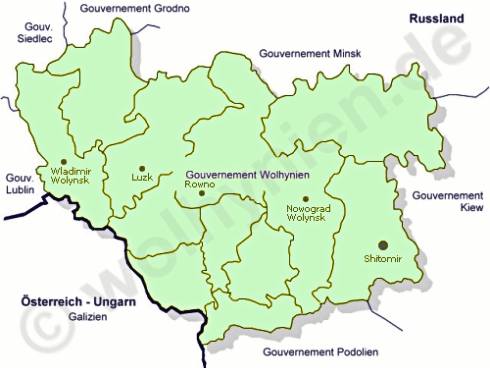
This movement of emigration went on well into the 1900s. Had Henry and Julia stayed with the outbreak of World War I, they would have had to give up any land they leased or owned. Laws passed in 1915 resulted in German landowners being forced to give up their land. This included colonists in the Matschulek colony whose names were published in a newspaper, Volinskija Gubernskija Vdomosti, No. 56, June 2, 1916, Zhitomir for Matschulek (Maczulki), District Rovno, Klevanskaya Volost. One of the colonists listed was a Dreger.
Afterward, the Russian government exiled the German Volhynian population to Inner Russia, Central Asia and Siberia. Germans who had no close relatives in the tsarist army had to leave Volhynia before Christmas 1915. A lot of them died even before being transported out to exile destinations while in camps. It started in July 1915 when Russian police picked up all of the German farmers who were drafted to be soldiers, leaving behind their families. Farms without inhabitants were looted by Russian farmers from nearby villages and burned.
It wasn’t until the Tsarist Empire collapsed and afterward German Volhynians were allowed to return starting at the end of 1917.
I found in the fall/winter 2011 Historical Society of Germans From Poland & Volhynia (HSGPV) newsletter an article about a memorial stone at a grave site in Maczulki, Kreis Rovno (Rivne) Volhynia, now Ukraine. One hundred and thirty German families settled there in 1867. In June 2011, 29 Germans and 5 Canadians took part in the stone’s unveiling.
This stone is significant in that among the surnames listed on it was the surname of Harmel. Recall, Henry’s wife Julia’s maiden name was Harmel. There is also the surname of Dreger that is related to Julia.
Also engraved on the stone on the other side of it in both English and Ukrainian are the words:
“In remembrance of the inhabitants of the former German colony Maczulki (Matschulek) who lived here, from 1867 until the resettlement of 1940, in good relationship with their Ukrainian neighbours.”

